Innovative solutions for global environmental protection, climate action and resource efficiency are critical to sustainable and long-term economic development. All companies and protagonists in infrastructure projects in DEG’s portfolio commit to complying with, or introducing, international environmental and social standards. DEG expects banks and funds to implement their own environmental and social management systems (ESMS) and to appropriately manage potential environmental and social risks for their customers.

82% of DEG’s direct customers already comply with international environmental and social standards.
DEG is continuously expanding its advisory services and provides targeted support to customers in developing transformation projects and transition plans. It also promotes climate-friendly business models, supports its customers’ investments in climate adaptation and resilience, and invests in carbon sink projects projects for the long-term capture of CO2.
The companies and projects financed by DEG have a total carbon footprint of 40 million tonnes of CO2 per year. This includes Scope 1 emissions, i.e. all direct greenhouse gas emissions, for example from own facilities or vehicles, and Scope 2 emissions, i.e. indirect emissions from purchased energy.
The total carbon footprint of companies taking out loans from financial institutions financed by DEG amounts to 164 million tonnes of CO2 per year. This includes Scope 3.15 emissions, which represent indirect greenhouse gas emissions arising from the activities of the companies promoted.
An important basis for effective climate protection is solid climate governance, i.e. clear responsibilities, decision-making processes and structures that support companies in managing climate risks and implementing climate targets. This governance works differently depending on the customer group:
Banks can promote environmentally friendly technologies and sustainable practices through their lending and investment decisions.
Companies can contribute significantly to climate protection by making their production processes and supply chains more efficient and climate-friendly. Climate protection measures also offer long-term economic benefits to industrial companies because they can help to increase efficiency and reduce climate risks.
45% of DEG’s direct customers have good climate governance in this regard.
26.1 TWh of electricity from renewable energies: technologies applied (direct customers)
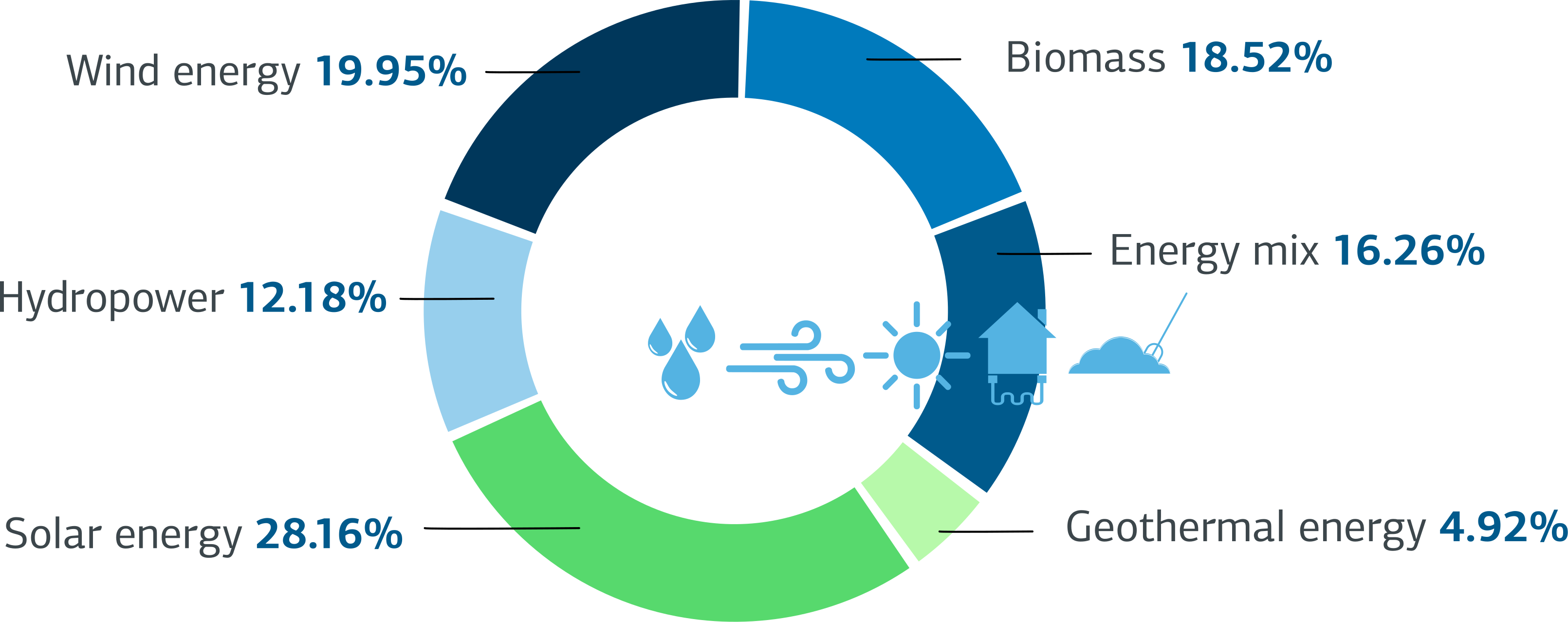
Both directly and indirectly financed energy projects make a substantial contribution to the provision of renewable energy and the supply of energy to the population. They also result in a significant reduction in greenhouse gas emissions. These commitments therefore not only help to improve access to sustainable energy, but also make a measurable contribution to reducing climate-damaging emissions and achieving international climate and development goals.
On an annual basis, energy utilities and power stations financed directly by DEG produce 26.1 TWh of electricity from renewable energy and can currently supply more than 37 million people.
This reduces emissions of carbon dioxide (CO2), the main greenhouse gas, by more than 14 million tonnes of CO2 per year.
In addition, companies that DEG invests in indirectly via funds produce 8.9 TWh of renewable energy and reduce emissions by a further 6 million tonnes of CO2 per year.
Sustainable energy supply for small and medium-sized enterprises
Name: Green Yellow
Invested volume (in USD): 28 million
Country: Thailand and Vietnam
DERa category: Environmental stewardship
The economies of Thailand and Vietnam are growing rapidly – driven by a large number of small and medium-sized enterprises. If they make use of renewable energy, they will benefit from sustainable growth and a self-sufficient energy supply. The French company Green Yellow supports green electricity production and energy efficiency measures in 15 countries worldwide and also wants to supply these services primarily to local SMEs in these two Far Eastern countries. The green electricity is produced using solar panels installed on roofs or via floating systems.
DEG provided Green Yellow with around USD 28 million in equity capital, earmarked for its activities in Vietnam and Thailand. With DEG's participation, it will be possible to expand the capacity of the solar plants in operation to 400 MW/p (megawatt/peak) annually by 2026.
The investment contributes to SDGs 7, 8 and 13.


